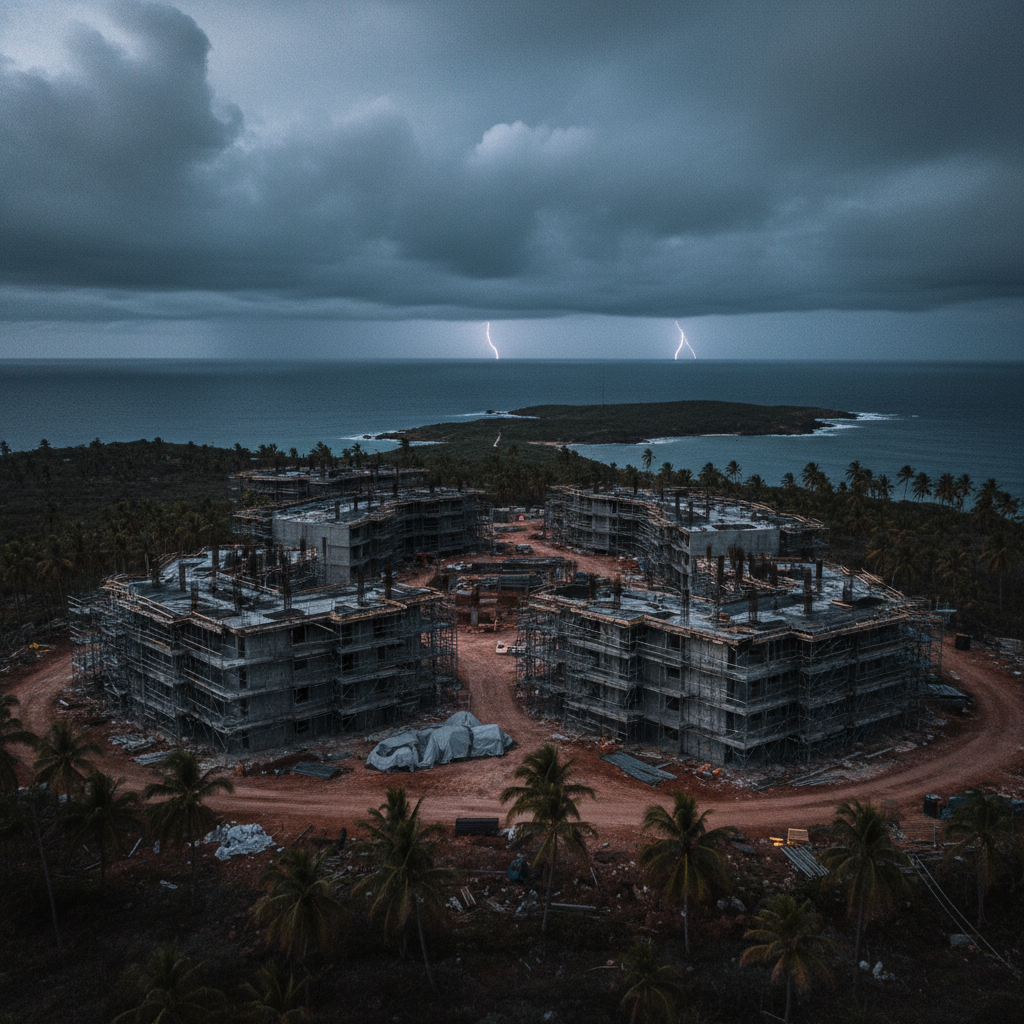
Gary Kerney** directed the construction and renovation of Jeffrey Epstein's private island for years — and 2,853 documents show exactly what he built, what it cost, and the permits filed to make it happen.
Kerney, operating through Landmark Land Co., served as Epstein's on-the-ground project manager for Little St. James — the 72-acre private island in the U.S. Virgin Islands. His emails with Epstein, released in the DOJ document dump, span from 2009 through 2011.
They reveal a construction program stretching across multiple buildings and millions of dollars on an island that became the center of federal trafficking investigations.
Get the full documents delivered to your inbox — subscribe to the InvArchives newsletter.
The Renovation Scope: Millions Across Multiple Buildings
Kerney's documents detail a sweeping renovation of the island's compound. A March 2010 email chain (Document vol00010-efta02012628-pdf) shows him laying out construction cost estimates for four separate structures.
The figures: a cottage at approximately $1.35 million, a pool building at $1.8 million, a piano room at $1.2 million, and an ATV building at $420,000 — a combined estimate of nearly $4.77 million for schematic design alone.
Kerney had a direct line to Epstein. He routed approvals, managed contractors, and coordinated payments through Epstein's inner circle. Emails show him copying Darren Indyke, Epstein's longtime attorney and estate executor, and Rich Kahn on financial decisions.
Gensler and the Architecture Chain
The island's design work was handled by Gensler, the global architecture firm, through its Santa Monica office. Warwick Wicksman, a Gensler principal, coordinated directly with Kerney on design phases for the pool, main residence, spa, and guest cottage (Document vol00009-efta00773756-pdf).
By August 2009, Gensler had outstanding invoices on the island project covering the balance of design development work and retainers for new phases. Kerney wrote to Epstein in an August 2009 email: "I was trying to get them paid as a condition of getting them to meet me on LSJ to get them working on the proposed changes."
The relationship required Kerney to manage competing contractor timelines, unresolved billings, and Epstein's direct design instructions — all while keeping the island's operations moving.
The CZM Permit Problem
Documents reveal a significant tension around the island's permitting process. The Coastal Zone Management authority — the regulatory body governing construction in the U.S. Virgin Islands — required submissions from locally licensed architects. Gensler was a California firm without that standing.
In a March 2010 email exchange (Document vol00009-efta00763256-pdf), Kerney wrote to Epstein: "We were told at our CZM meeting that submittals were required to be from local architects, Gensler's plans were submitted with McGuire stamps, I'm sure for a fee."
Epstein was blunt about the design drawings. In a separate email (Document vol00010-efta02012628-pdf), he told Kerney: "he cannot design, these are only throw aways for czm purposes."
Kerney confirmed the local architect's role: Robert deJongh, described as the island's "adviser on CZM submittals," knew "the plans are for permit only and will be changed after entitlements."
The $56,807.69 CZM permit package from deJongh covered schematic design sets for four island structures.
Managing the Island's Day-to-Day Build
Beyond permit filings, Kerney's documents show hands-on construction management. A November 2010 email (Document vol00010-efta01979682-pdf) has Kerney advising Epstein on when to solicit contractor bids for mechanical, electrical, and plumbing work — recommending waiting until after schematic design to control costs.
In a 2011 email exchange (Document vol00010-efta01982107-pdf), Epstein directed Kerney to explore enclosing the island's pool in a building and assess the cost and timeline impact.
Kerney also coordinated sourcing of specialty materials. A 2011 chain shows him searching for cobalt blue pool tile for the main compound and a blue-green tile for a second pool — 120 square feet of each, requiring Epstein's personal photo approval before installation.
Doug Schoettle appears throughout the documents as another key figure in island operations, consistently copied on construction communications alongside Kerney.
Conclusion
The 2,853 documents naming Gary Kerney place him at the center of years of construction activity on Little St. James. He oversaw millions in renovation work, managed relationships with top-tier firms like Gensler, and navigated a permitting process that — in Epstein's own words — was fed plans designed as throwaways.
The island he helped build became the subject of federal trafficking charges filed against Epstein in 2019.
All individuals mentioned are presumed innocent unless proven guilty in a court of law.
Share this investigation
This analysis references publicly released documents from the Epstein case archive. All individuals mentioned are presumed innocent unless convicted in a court of law. Language such as “documents indicate” reflects what appears in source materials, not conclusions of guilt. Readers are encouraged to review the cited source documents directly.